
This month across Children’s House, we have focused on table manners, independence, and mealtime grace and courtesy. Sitting together for a meal is one of the richest social experiences of the day, and refining these skills helps our children feel capable, independent, and considerate of those around them.
How We Practise at School
During circle times, we talked about how our actions at the table affect the whole community. We used hands-on presentations to make learning these skills engaging and fun:
- Cutlery practice with playdough: To help the children master using a knife and fork, we worked with playdough! The children rolled dough into “sausages” and flattened it into “burgers,” then practised holding a knife and fork correctly to slice their creations into pieces. This playfully builds the exact motor patterns needed to cut real food without using hands. Check out our Instagram account to find out more!
- Pouring water with jugs: Pouring water is a central practical life activity in Children’s House. During our daily Montessori work cycle, children practise pouring water using various small jugs and containers of different sizes and handle styles. In the canteen at lunch, each table has small water jugs where children independently fill, bring to the table, and offer water to their friends before pouring their own.
Benefits Beyond the Table
Refining mealtime routines supports child development in profound ways:
- Fine motor and bilateral coordination: Holding a fork steady while cutting with a knife or pouring from a jug requires using both sides of the body in a synchronised way. Research shows that developing bilateral integration in early childhood directly strengthens hand-eye coordination and spatial awareness needed for handwriting.
- Independence and self-efficacy: When children pour water or serve themselves, they develop real confidence in their own physical abilities. Occupational development research confirms that supporting self-feeding and self-care routines strengthens both motor mastery and personal autonomy.
- Social connection and positive behaviour: Sharing responsibilities at the table fosters social awareness and cooperation. Studies on family mealtime environments show that structured, autonomy-focused mealtime routines promote positive emotional experiences, turn-taking, and self-regulation.
Find out more: why feeding time is important for child development and bilateral coordination.
Ways to Support at Home
You can easily build on what your child is learning at school during your family meals:
- Use real materials: Offer real glass cups and ceramic plates rather than plastic. Real materials provide natural feedback; children handle glass with genuine care and respect, which builds spatial awareness and delicate control of movement.
- Provide a small pitcher at the table: Place a small, light jug of water at the dinner table so your child can fill their own glass and offer drinks to family members. Pouring independently builds motor precision, concentration, and pride in contributing to the family.
- Involve them in setup: Let your child set the table with a fork, knife, spoon, and glass. Matching items to places builds practical life skills and spatial ordering.
- Model grace and courtesy: Using “please pass the water” or “thank you” naturally at the table inspires children to mirror the language and care modelled around them.
Country of the Month: Exploring the USA
Over the past few weeks, our cultural journeys have taken us across the Atlantic as we explored the United States! The children loved discovering Andy Warhol and creating their very own vibrant pop art prints in class.
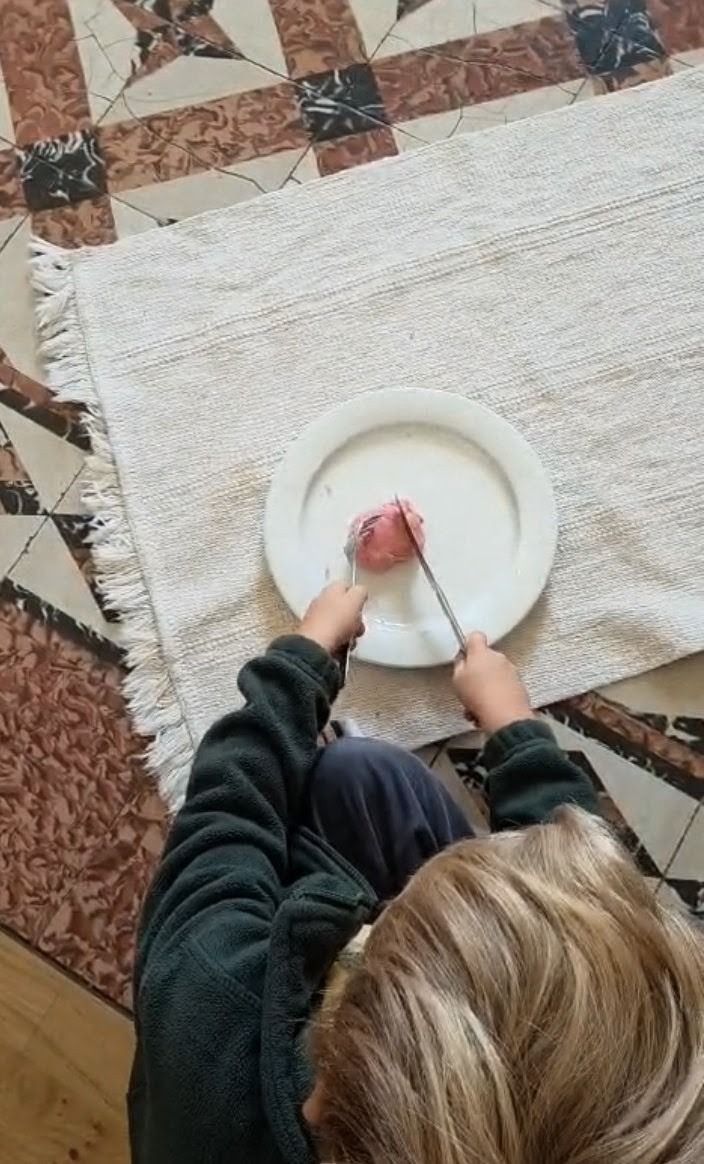
Our explorations also brought us into the kitchen, where parent volunteers helped us make authentic American-style Thanksgiving mashed potatoes! On the last Friday of the month, we will celebrate with traditional burgers for lunch, giving the children a fun chance to put their cutlery skills into action with real burgers, just as they practised with playdough!
Whenever we feature a Country of the Month, we love welcoming parent volunteers. If we are celebrating a country your family is connected to, please let us know: we would be delighted to have you share a story, recipe, or art activity with the children.
Thank you for your partnership in helping our children build confidence, grace, and community!